
Eric Maggiori on the Culture of Vintage and the Power of Storytelling
The first time Eric Maggiori understood what clothes could do, he was in Tokyo. It was 2004 and,...
No products currently in your bag

After 15 years in Japan’s denim industry, Yuki Nagaoka wanted to make jeans that looked forward. He had no doubt about the technical skill around him. The quality of Japanese denim was among the finest in the world, but he was drawn to the freedom and creative challenge he saw in jeans from other countries. Milestone Basement began as a way to bring those cultures together and explore what Japanese denim could become next.
Those That Know was the first store outside Japan to carry Milestone Basement. When we spoke to Nagaoka in 2021, the collection was deliberately small: two pairs of jeans, one denim jacket and a handful of T-shirts. Behind that restraint was a clear philosophy encompassing Zen, everyday utility and the rhythms of jazz and hip-hop.


Milestone Basement is not without vintage influence. For Nagaoka, the difference is one of perspective: “like rock ’n’ roll and hip-hop; they’re both music”. He rejects the idea that denim must be deliberately distressed or worn according to a rigid fading regime in order to become beautiful.
“Vintage jeans are beautiful because they bear the traces of more than half a century of somebody’s everyday life. No one wore those jeans solely for the purpose of ageing them. They washed them when they needed to be washed and simply wore them as part of a daily routine. That is why they are so beautiful.”
His own jeans are pre-washed and sun-dried so that they can be worn comfortably from the moment they are bought, without shrinkage, stiffness or elaborate preparation. They are intended as everyday clothes rather than occasional luxury objects. A trusted craftsperson handles the washing and drying of every pair, allowing the character of the denim to emerge naturally through use.


“Just by wearing them in your everyday life, you will see the true beauty of our denim shine through.”
Simplicity, in this context, is not the absence of design. Nagaoka describes it as an “aesthetic of subtraction”, deeply influenced by Zen. A modern denim jacket does not become more relevant by accumulating extra functions and details; it becomes clearer when everything unnecessary is removed.
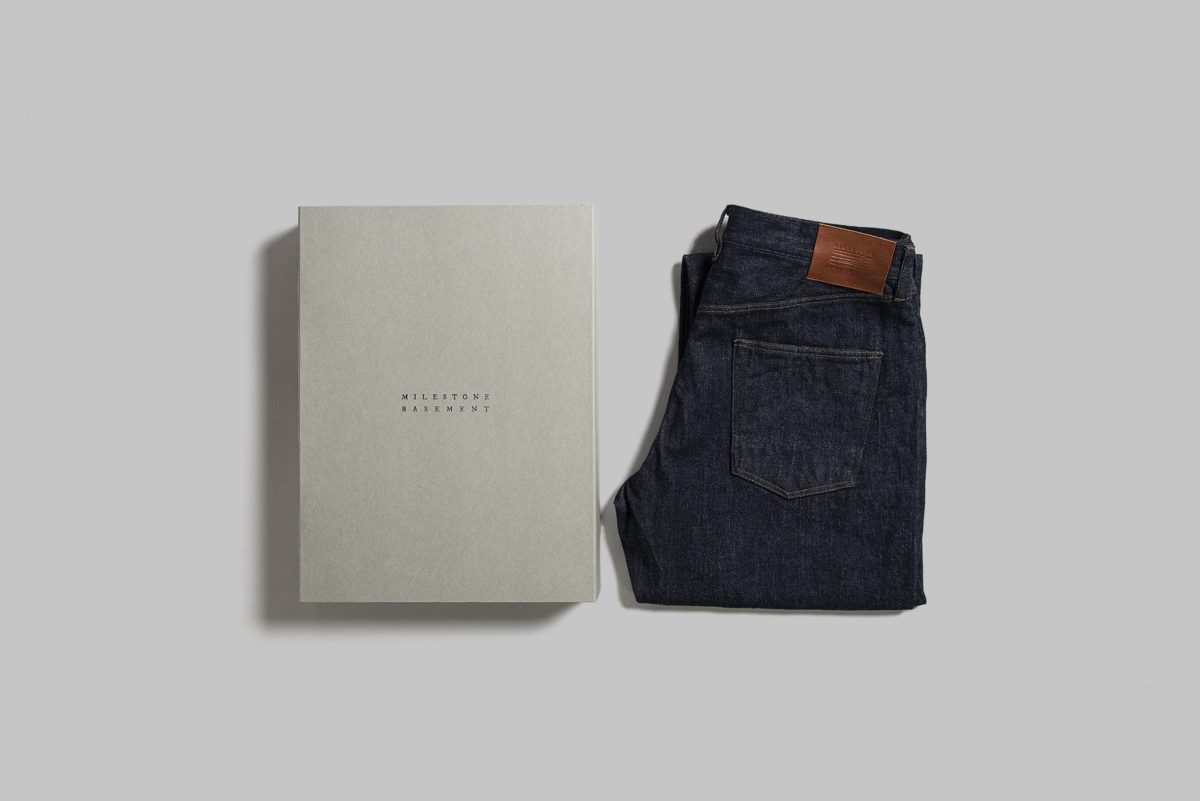
The same reasoning explains the compact product line. Milestone Basement wants its garments to become essential parts of their owners’ lives, not pieces kept untouched in a wardrobe. “In this case, three is enough, isn’t it?” Nagaoka says. New products can follow as the brand grows, but not at the expense of that focus.


The fabric is developed with a trusted denim mill in the Ibara area of Okayama Prefecture. At 12.5oz, it balances durability with the comfort required for daily wear. A pure white selvedge line, rather than the more familiar red, runs against the blue ground as a quiet expression of the brand’s identity.


The old shuttle looms are operated by craftspeople who monitor several machines at once, listening to the movement and sound of each shuttle and making constant adjustments. Nagaoka compares the concentration and responsiveness to a jazz session: analogue equipment, skill and experience working together in real time. For him, that method creates a beauty unavailable through mass production.
Okayama’s history as a denim centre makes those relationships possible, but the brand’s cultural references extend well beyond its home town. Tokyo and New York are important visual influences, while music runs through Milestone Basement’s journal and identity. Hip-hop and jazz were once relatively small scenes in Japan; by 2021, both had found much broader audiences, particularly hip-hop.
Nagaoka recommended Ovall, toe, RITTO and Dengaryu as starting points, while also naming Hikaru Utada as a major influence. His taste is not limited by genre.




For physical music, he pointed to Waltz in Nakameguro, Tokyo: a specialist cassette shop where the collection is meticulously organised and an entire day can disappear among the shelves. Milestone Basement later featured the store in its own journal.


At the time of our conversation, Nagaoka’s ambition was to introduce Milestone Basement to more people, develop the collection carefully and use the brand to carry Japanese culture into the wider world. It was a suitably expansive goal for a label built on subtraction.
This interview has been edited and condensed for clarity.
Explore the current collection on the Milestone Basement brand page. If you would like more information, email sales@thosethatknow.co.uk.

The first time Eric Maggiori understood what clothes could do, he was in Tokyo. It was 2004 and,...

Papa Nui began with $345 from a shop bonus. More than a decade later, after over 100 cap...

Ryota Yamasaki’s understanding of knitwear began with a single T-shirt. Before founding Loop & Weft, he worked in...
Jonathan Lukacek spent almost ten years trying to make a bandanna properly. The search took him through thousands...
When we spoke to The Rite Stuff founder Bryan Shettig in March 2020, his young label was already...

Papa Nui began with a practical problem under the Australian sun. John Tesoriero was wearing an inexpensive reproduction...
Stay in the know
Sign up for occasional updates from Those That Know.
You are now signed up to receive updates from Those That Know.